Table of Contents
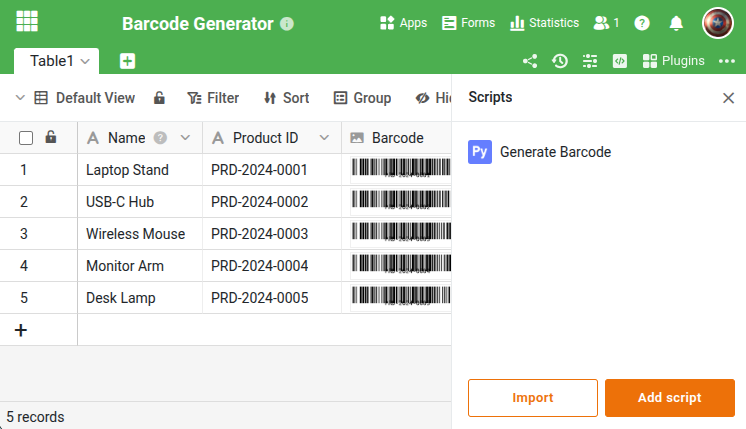
This script converts text values (e.g. product IDs, serial numbers) into barcode images in Code 128 format and stores them as images in SeaTable. The script iterates through all rows and skips those that already have a barcode. It is suitable for manual execution or as an automation.
Prerequisites
The table requires at least two columns:
- A text column with the value to be encoded as a barcode (e.g. “Product ID”)
- An image column where the generated barcode will be stored (e.g. “Barcode”)
The script
Adjust the three variables at the beginning to match your table structure. You can customize the barcode appearance via the options (width, height, font size, etc.).
from seatable_api import Base, context
import barcode
from barcode.writer import ImageWriter
from io import BytesIO

base = Base(context.api_token, context.server_url)
base.auth()

TABLE_NAME = "Table1"
TEXT_COLUMN = "Product ID"
IMAGE_COLUMN = "Barcode"

rows = base.list_rows(TABLE_NAME)
for row in rows:
    text = row.get(TEXT_COLUMN)
    existing = row.get(IMAGE_COLUMN)
    if not text or existing:
        continue

    code128 = barcode.get_barcode_class('code128')
    rv = code128(str(text), writer=ImageWriter())

    buf = BytesIO()
    rv.write(buf, options={"module_width": 0.4, "module_height": 10, "quiet_zone": 1, "font_size": 10, "text_distance": 2})
    buf.seek(0)

    info = base.upload_bytes_file(str(text) + '.png', buf.read(), file_type='image')
    base.update_row(TABLE_NAME, row['_id'], {IMAGE_COLUMN: [info.get('url')]})

print("Barcodes generated.")
Execution
The script can be started in three ways:
- Manually in the Python editor of the base
- Via automation (e.g. scheduled or on new rows)
- Via button — for this the script would need to be adapted to process only the current row
Learn more about this here .
For the complete function reference, visit the SeaTable Developer Manual .