
Create a checklist for your move #
Start planning your move with a brainstorming session. What tasks do I need to complete? Who can help me with them? How much budget can I spend? Then draw up a cost overview to estimate your expenses. In a checklist, you can define initial tasks and work through them.

All about the move: leases, security deposit and key handovers #
The new lease is signed and your move out of your old apartment is settled. Now it’s time to terminate your old lease. The notice of termination must be given on time and in writing; usually, a notice period of three months applies. However, if you want to end the tenancy earlier than agreed in the contract, you should talk to your landlord beforehand. In this case, you may be responsible for finding the next tenant yourself.
Shortly after your move, you should schedule the handover of the apartment and keys. For this, you must leave the apartment as agreed in the lease. This usually includes cosmetic repairs and leaving the apartment broom-clean. After the handover, you will get your security deposit back and can fully concentrate on furnishing your new home.

Special leave for your move #
With careful planning of the handovers, the first step of your move is done. But the subsequent moving out of and into the apartments takes a lot of energy and time. Therefore, it may make sense to take a day or two off for a larger move. If you would like to get time off from work for this purpose, first ask yourself the following questions:
Entitlement to special leave #
Am I entitled to statutory special leave?
What does my employment contract say?
What if I move for work reasons?
Work-related reasons for the move #
What reasons make a move 'work-related'?
Are there different rules if I work in the public sector?
Organize the move #
Once the day of the move is set, the next step is planning. You basically have two options: a move with a moving company or a move on your own. Which of the two options suits you depends on your budget, the size of your household and how well you handle stress.
The complete package: hire a moving company #
With a moving company, you save yourself a lot of time and nerves. Everything you would otherwise have to organize yourself is taken care of. Especially if you are moving with several people or are under time pressure, the move is done quickly and comfortably. But one thing is also clear: If you want to do as little as possible yourself, you will have to dig deep into your pockets. How much exactly you have to budget varies and should be discussed in detail with the moving company. Roughly speaking, however, the costs depend on the distance to your new home and the size of the apartment. This average calculation serves as a guide:
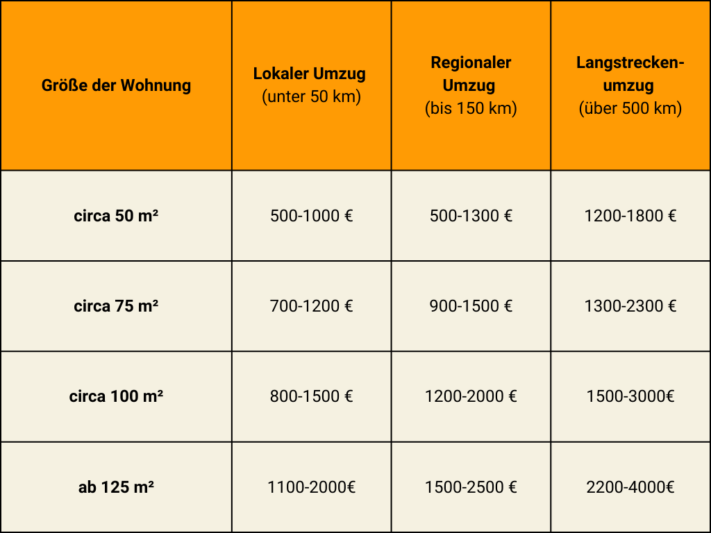
For your money, however, you get a complete service. This also includes the company being liable for any damage to your belongings, the apartment or the staircase during your move. The law stipulates that 620 euros per cubic meter of transported goods are assessed in the event of damage. If you want to have particularly valuable items transported, you can agree on a higher liability amount with the moving company. But be careful: If you pack your furniture and belongings yourself, the professionals will not assume any liability for damage caused during transport.

Services of a moving company #
How much support you want from a company is up to you. Usually, you have several models to choose from:
- Standard move: loading and transport
- Complete move: packing and unpacking boxes, dismantling and assembling furniture, loading and transport
- Additional services: setting up a no-parking zone or temporary storage of furniture
For bargain hunters: organize the move yourself #
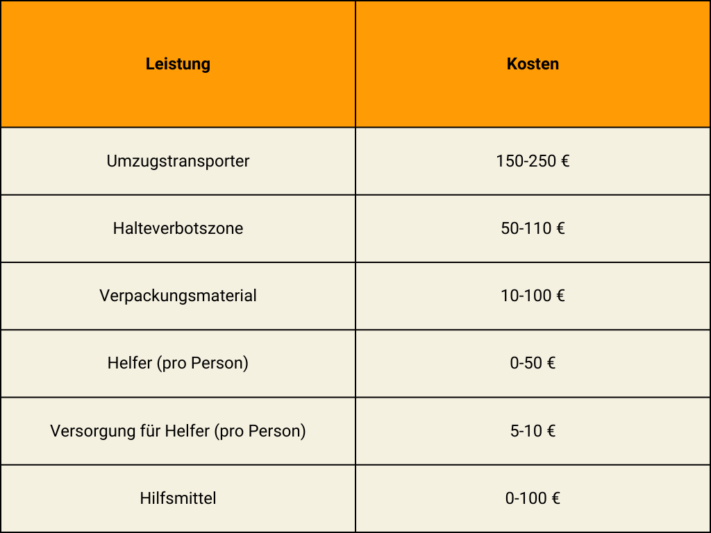
If you want to save costs, a move on your own is exactly the right thing. However, the organizational effort is higher. Everything that is included with a moving company is now in your own hands. But with good planning, nothing stands in the way of this project. A moving plan that supports you through every step along the way will help you. These are the expenses you will incur when moving on your own:
Tasks when you plan a move yourself #
Organize everything yourself? No problem! The following tasks will come your way:
- Transport: Ask friends or relatives if they can provide their vehicles, or rent a van. With the latter, there are costs for fuel and mileage in addition to the rental costs.
- Apply for a parking ban: Especially in a big city, it is tedious to find parking spaces near your apartment. So that you don’t have to carry your boxes and furniture so far and loading and unloading the vehicles goes faster, you can apply for a parking ban at the road traffic office. There you can borrow the signs that mark the parking ban. You should submit the application three to four weeks before the move.
- Packing materials: Cardboard boxes are best for transporting your items. The rule of thumb is: number of square meters = number of moving boxes needed. First ask your friends and acquaintances whether anyone has moving boxes; then you can save yourself buying new ones. You will also need tape and filling material such as kitchen paper or bubble wrap for fragile items.
- Find moving helpers: Your first point of contact should be your relatives and friends, as they will surely be happy to help you without payment. If too few of your acquaintances have time, you can look for additional helpers, but you will have to pay them. To do this, you can ask around your neighborhood or post a call on your social media. Also remember to get enough food and drinks for your helpers on moving day.
- Tools: To make the work easier for your helpers and yourself, tools such as work gloves, tension straps and a hand truck for transporting heavy objects are recommended. When no professionals are at work, injuries can occur more frequently. So be prepared for the worst and have a first aid kit on site.

Who you should inform about your move #
The move is just around the corner and you want to tell everyone your new address. Don’t just think of friends and relatives, but first of all of authorities and companies with which you have concluded contracts. Probably the most important place to go after your move is the residents’ registration office. You must register your new address there within 14 days of your move. You can also re-register your car there. Remember to book an appointment in good time, as they are usually booked up well in advance.
Where else you should provide your new address: #
- Banks and insurance companies (e.g. health, liability, household contents, legal protection insurance)
- Electricity, gas and water suppliers
- Telephone and internet providers
- Broadcasting fee (will be sent to you)
- Subscriptions (e.g. magazines)
- Memberships (e.g. gym, clubs)
- Online shops and parcel services
Deducting a work-related move from your taxes #
In Germany, you can deduct part of your moving costs from your taxes as income-related expenses. These are divided into general and other costs and make up a large part of the tax-deductible costs. Attention: If your employer covers some or all of your moving costs, you cannot claim the covered costs again in your tax return.
General costs #
There are some general costs that you can declare in full in your tax return. Very important: Keep invoices and receipts so that you can prove your expenses. General costs include, for example, transport costs for household goods, double rent during the moving period or the broker’s commission.

Keep all invoices and receipts to claim your expenses for tax purposes.
Other costs #
You may deduct other costs as a lump sum. It is therefore not necessary to keep every receipt. The moving expenses lump sum is particularly worthwhile if you are moving on your own. It covers many smaller expenses. These include, among other things, food and drinks for the moving helpers, installing the kitchen, updating your ID card and re-registering your car.
In Germany, the lump sum has been 886 euros since April 1, 2023; you can claim an additional 590 euros for each additional person. If you did not have your own household before your move, the lump sum is only 177 euros.
Of course, you don’t have to use the lump sum. If your expenses exceed the costs covered by the lump sum, you can claim them for tax purposes with receipts, just as with general costs. Renovating the old apartment, e.g. contractually agreed cosmetic repairs, is also covered.

Deducting a private move from your taxes #
If you move for private reasons, you cannot deduct moving costs from your taxes. Nevertheless, you are not completely without options. You can declare labor and travel costs for a moving company. However, you must keep in mind that a maximum of 20,000 euros per year may be declared for service provider costs, of which no more than 4,000 euros result in a tax advantage. If you are considering this, declare the costs as household-related expenses.
A move for medical reasons counts as an extraordinary burden. You can also claim it in your tax return, but only with detailed proof of your health situation.
Online planner for your move #
To make your next move as stress-free as possible, the SeaTable team has created a template for your moving plan. You can adapt it to your needs as you wish.
If you want to use SeaTable to plan your move, simply register for free. You can find the corresponding template here.
TAGS: Everyday Life & Leisure