
What is a bullet journal? #
A bullet journal helps you organize your everyday life and keep track of all your tasks, appointments and needs. The journal functions as a combination of appointment calendar, project planner and notebook. It also offers enough space for the topics that matter to you personally. A bullet journal sets no limits to your creativity, because unlike conventional calendars, it has no pre-made pages. You design them yourself and fill them according to your own ideas.
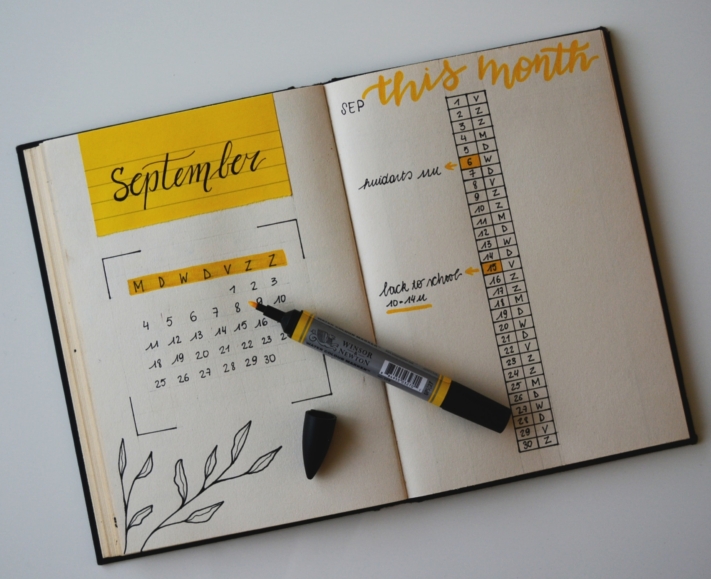
Your bullet journal grows with every new entry. As soon as all the pages are filled, you start a new book.
The story behind the concept #
This calendar method was invented by New York graphic designer Ryder Carroll. Born in Austria, he developed a system for himself to plan tasks better and carry out projects in a more targeted way.
His idea: a journal without rules and without space problems. Carroll published his bullet journal in 2013. Many enthusiastic bullet journalers built on his practical foundation and developed their own creative content. Today, there is a large community that shares its ideas on social media and blogs.
The right starter pack #
Getting started with bullet journaling could hardly be easier. All you need is a notebook and a pen. It is a good idea to start with what you already have at home. That way, you can find out whether journaling suits you. If you enjoy it and want to get more creative, you can buy additional supplies.

Notebooks with a dot grid serve as a basis, as it offers more freedom for writing and drawing than conventional lines or squares. If you want to design your pages in an original way, there are some extra materials you might like. These include highlighters, fineliners, brush pens, washi tape and stickers. If you are not sure which supplies to get, there are also ready-made sets.
The structure of your bullet journal #
As mentioned above, the focus is on putting your own ideas into practice. However, there is a basic system that you can use as a guide for structuring your journal.
It consists primarily of time-based overviews in which you can enter your tasks and appointments. In addition, there are collections. These are pages that give you room for free, individual expression. Below you will find a collection of ideas that you can adopt or draw inspiration from.
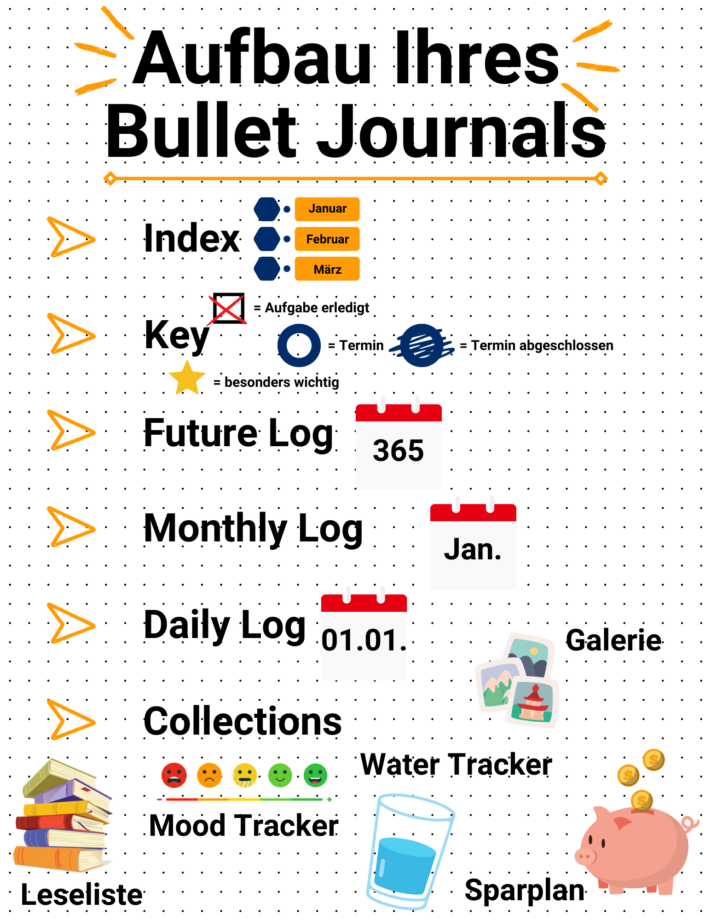
Design your journal according to this template.
The basic system #
The basic structure of your bullet journal consists of three parts. The index serves as a table of contents so that you can find your entries more quickly. To keep it up to date, you should maintain the index regularly.
This is followed by the key, a kind of legend in which the symbols and their meanings are recorded. This technique is called rapid logging.
The third part contains the calendar views. Start with the future log, your annual plan in which you record major and important events.
Building on this, you then create a monthly log. It shows all important appointments of the respective month at a glance. This is where you enter appointments and tasks that are not part of your daily routine.
The daily log goes into even more detail. It is created week by week and lets you flexibly enter the events of each day.
The collections #
This is where it gets creative! There are hundreds of templates on the internet showing how you can fill your bullet journal with content. Let our ideas inspire you and adapt them to your own preferences – or get inventive yourself.
Many ideas can be implemented as lists. The point is to list things that you like and do not want to forget. Classic examples are the bucket list, the to-do list or the wish list. You can also record your interests in this form. Start a list of your favorite movies or create an overview of books you still want to read.
Trackers are probably the best-known addition to the bullet journal. They help you document recurring tasks. There are different types of trackers:
- Habit tracker: Establish new habits and get rid of bad ones. You can find a detailed article on this here.
- Mood tracker: Record how your mood changes over a longer period of time.
- Sleep tracker: Monitor your sleep times and how well you slept.
- Water tracker: Make sure you drink enough water every day to stay healthy.
Another way to put your plans into action is to set goals. Combined with trackers, you can make your goals measurable and check your progress at any time. Possible goals include New Year’s resolutions, e.g. reaching a savings target or improving your grades.
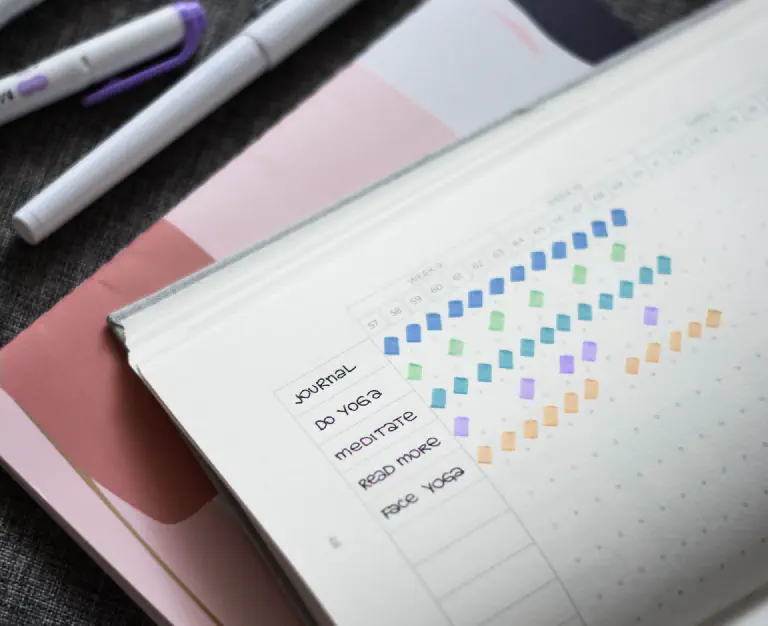
A habit tracker is a popular addition to the bullet journal.
Why a bullet journal is worthwhile #
There are many good reasons to try bullet journaling for yourself. Here are some of them:
Smart organization #
For most people, the main reason to start journaling is the organizational support. Thanks to the interplay of calendar and planner, important appointments no longer get lost. In addition, a bullet journal helps you write down the topics you want to tackle and thus manifest them. The key and the index provide an overview and make it easier to find and work on your tasks.
Versatile in use #
Your ideas – your bullet journal. It adapts to your needs and does not have to follow a set pattern. You can use it to organize your daily appointments and tasks; the built-in tools such as the calendar or the to-do list are ideal for this. At the same time, you can get creative and let your imagination run free in the collections.

Combine functionality with creativity.
Documenting changes #
Because you write everything down in your bullet journal, you can check at any time what you did when and whether you are getting closer to your goals. Draw conclusions from your behavior and try to make your everyday life even more effective and stress-free. The bullet journal is a living system that changes with you. Try out new things in the collections and remove topics that no longer appeal to you.
If the journey is the destination, then we need to learn to travel better.
Improving your quality of life #
For its inventor, Ryder Carroll, what matters is that the bullet journal improves your life. There is no right or wrong when it comes to enjoying life in the here and now. This includes journaling giving you a break from everyday stress and a chance to reflect on your life. For some people, creative writing can have a meditative effect. What’s more, a lot of work goes into your bullet journal. It is something you made yourself, which increases its emotional value and makes it easier to stick with it.
Template for your digital bullet journal #
An alternative to the analog notebook is a digital bullet journal. SeaTable offers you a simple and effective way to design your calendars, lists and trackers digitally and to restructure them flexibly with just a few clicks. Adapt the free template to your needs and add your own ideas. The bullet journal includes an integrated habit tracker, which is a practical addition to your journal. Work with colors, symbols and images to give your journal a personal touch.
If you would like to use SeaTable for your bullet journal, simply register for free. You can find the corresponding template with lots of inspiration and sample entries here.
TAGS: Everyday Life & Leisure