
How RAG Is Changing Knowledge Retrieval #
AI agents should not only find corporate knowledge but also reliably translate it into decisions and actions. To achieve this, it is rarely enough to vectorize wiki pages and send the most similar text segments to an LLM. In addition to semantic search, a productive RAG system requires a database in which entities, relationships, states, and access rules are preserved and remain recognizable to the AI.
Key Facts: #
-
The Limitations of Unstructured Data: Why vector databases and text-oriented tools like Notion, Obsidian, or Confluence can contribute to a loss of context when used with complex AI agents.
-
Structure as a Quality Factor: How structured no-code databases, serving as a single source of truth, enable precise queries and largely reproducible AI responses.
-
Architecture of the Future: What roles retrieval-augmented generation, AI agents, and MCP (Model Context Protocol) servers play in your company’s AI knowledge management.
-
Cost and Data Control: How to improve governance and cost control through metadata filtering, targeted retrieval, and higher token efficiency.
What Does RAG Mean? #
The acronym RAG stands for Retrieval-Augmented Generation and refers to a specific approach for connecting language models with external knowledge sources such as corporate databases. Instead of relying exclusively on training data, the RAG system first searches for relevant information and passes it on as context to the AI model being used. This principle has made RAG AI a central building block for modern, domain-specific corporate assistants. Vector search can search large databases for semantically similar content and significantly reduce the amount of context that is actually processed.

For companies, this means they do not have to retrain their language models every time internal documents are updated. Instead, modern RAG AI knowledge management retrieves up-to-date sources and dynamically provides domain-specific knowledge. Passive documentation thus potentially becomes what is known as actionable data, which RAG AI agents can use to invoke additional tools or trigger processes.
The Weakness of Traditional Systems #
However, the quality of an RAG system depends to a very large extent on what data is actually indexed and how chunking and indexing work. Often, systems treat nearly all stored knowledge the same way: The content is extracted, broken down into chunks—that is, smaller units—vectorized, and stored in a RAG database. This approach works well for narrow queries that search for similar phrasing or matching text segments. However, as soon as you ask a more complex question that requires your AI agent to draw on multi-level relationships between data, precise filters, or aggregations, it becomes more difficult to obtain reliable, deterministic AI answers in such a setup.
Depending on the provider, you can perform limited filtering and aggregations via an API. However, this only partially resolves the problem of missing relationships, and you remain dependent on the quality of the API’s filtering capabilities. In addition, using an API sometimes involves additional costs—unnecessary costs, since you can perform the same queries directly in a relational knowledge database.
Vector Databases: Strong on similarity, weak on exactness #
Vector databases such as Pinecone and Chroma store embeddings and are optimized to quickly detect similarities between chunks. This does not mean, however, that they are unstructured. In addition to vectors, they can also manage IDs, text, and metadata. One drawback of typical vector databases, however, is that they do not automatically model referential integrity.
Let’s take a typical CRM setting as an example. Using a vector database, a classic RAG system can, for example, answer the question: “Which support requests are similar to this ticket?” However, a question that requires various pieces of information to be contextualized and combined—such as “Which active customers in Country X with annual revenue greater than Y have submitted a support ticket in the last 12 months?”, on the other hand, requires precise links and filters, for which the RAG system must be combined with an SQL knowledge base.
Notion, Obsidian & Confluence: Eliminate Document Chaos, but Don’t Provide Structured Data #
Even Markdown- or block-based systems like Obsidian, Notion, or Confluence are not fundamentally unstructured. It is more accurate to refer to them as semi-structured systems:
-
Notion databases support typed properties
-
Obsidian supports YAML-based properties
-
Confluence can store JSON properties
Due to their page-based structure, these systems are only partially suitable as a foundation for your company’s AI knowledge management. Often, they are still used merely as a collection of pages—as a corporate wiki lacking metadata, with inconsistent naming conventions, non-uniform properties, and duplicate entries. If you build AI knowledge management on such a system, the usual wiki chaos doesn’t disappear, nor does it suddenly become structured. It merely becomes semantically searchable.
The Problem of Context Loss: Why LLMs Can Hallucinate Without a Clear Data Structure #
Why is the lack of context a problem? When processing documents or internal knowledge databases, structure can be lost in several places. The key risk factor with unstructured or semi-structured databases is what’s known as lossy transformation: A source document or piece of information is broken down into chunks; each chunk is vectorized separately and, during subsequent queries, is primarily selected based on semantic similarity to the task at hand. Tables are converted to text, headings are separated from their corresponding sections, connections between related statements are weakened, and links between objects are reduced to mere words. If your RAG system subsequently finds only individual chunks, RAG may pass potentially correct statements to the LLM. However, the context that limits their validity is lost.

An example: You have customers in different regions with different contract terms. Without complete context, an agent may retrieve factually correct information that does not apply to the specific location or customer due to special factors.
Context loss can occur at several stages:
-
Ingest: Tables, properties, links, or block hierarchies are reduced to plain text.
-
Chunking: Related information ends up in different chunks
-
Embedding: Similarity in meaning is represented, but logical or causal relationships are not automatically captured.
-
Retrieval: A pure vector search finds semantically similar passages but does not necessarily retrieve all relevant information.
-
Prompting: Metadata and relationships are not provided, or relevant content gets lost in an overly long context.
Why Larger Context Windows Do Not Prevent Context Loss #
To prevent hallucinations or retrieval errors, you can provide the AI with as much context as possible in the query. However, this is not a reliable solution. This is because larger context windows increase the so-called “Lost in the Middle” risk. Research shows that information can be utilized with varying degrees of reliability depending on its position within long context windows. In addition, performance degradation has been regularly observed simply due to longer inputs.
Loading as much information as possible—or even entire documents—into the prompt therefore not only reduces your token efficiency; it can also create more distractions when the LLM has to process a large amount of information. Costs typically rise with the number of tokens processed—though not necessarily exponentially—since API providers bill for input and output tokens based on volume. Knowledge Retrieval Optimization means providing as little context as possible while ensuring it is fully relevant.
What advantages do structured, relational no-code databases offer for RAG? #
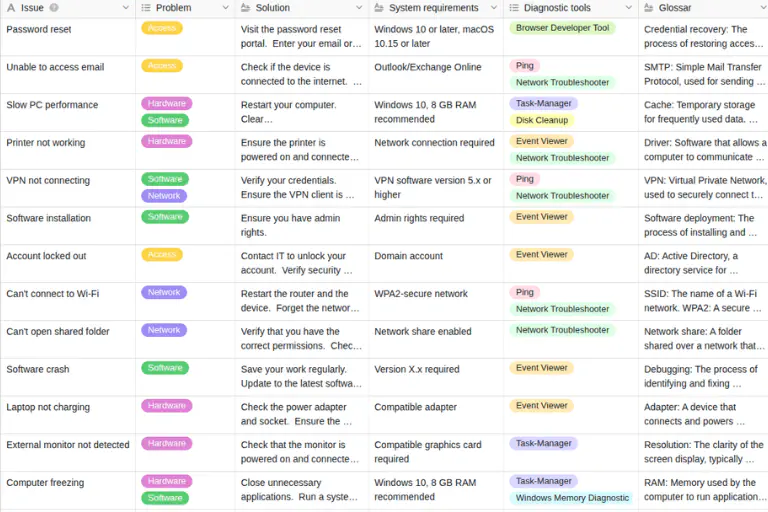
A structured, relational no-code database can, for example, store customer information, products, assets, or contracts as separate tables. Links between the tables map out the relationships, and unique data types and required fields reduce ambiguity. This results in structured, contextualized data that your AI agent can filter, sort, connect, and aggregate, rather than having to guess connections from text fragments.
This data architecture is what enables deterministic—that is, reproducible—AI responses: Your database query will return the same result given identical data and conditions. Your LLM formulates this result in natural language.
However, this does not mean that every response is correct. Generative AI can still make mistakes, even if you provide structured data for AI solutions. However, the critical facts come from a traceable query and not from a similarity estimate.
A no-code solution offers an organizational advantage for your AI-based knowledge management: Business departments create and maintain data models and processes themselves, without having to delegate every change to the IT department.
Vectorization vs. Structuring: RAG Systems Need a Hybrid Structure #
First of all, the question of vectorization versus structuring is not a strict either/or choice. Vectorization uncovers similarities in meaning; structuring allows you to explicitly query facts and relationships. An effective, modern RAG system should combine both principles. If your internal knowledge database already provides information in a structured format, RAG systems will produce more deterministic results than if data and information first have to be filtered and structured via the API. Therefore, you should store structured core information in a relational database. You can store documents in suitable content management systems; for example, this could be the same relational database if it is suitable for this purpose.
| Requirement | Suitable Access Method | Example |
|---|---|---|
| Semantic similarity | Vector search | Find similar support cases |
| Exact condition | SQL or filtered API | Active contracts for a specific plan |
| Listing relationships | Relational join | Assign tickets to the correct customer |
| Aggregation | Database query | Count critical tickets per customer segment |
| Free-text document query | Hybrid search | Find relevant policies or text passages |
RAG LLM components receive semantic chunks when meaning is crucial, and structured query results when facts and calculations are involved. Metadata filtering narrows the search space—for example, by language, status, document type, or creation date. This results in shorter contexts for RAG AI and manageable costs.
MCP Server and AI Agents: The Modern Architecture for Enterprise Search #
The Model Context Protocol standardizes the connection between AI applications and external resources or tools. In the MCP architecture, a host manages individual clients, each of which is connected to an MCP server. Your AI agent with RAG architecture identifies relevant databases via an MCP server and performs a targeted query. The RAG system loads only the necessary rows or document passages and, provided you grant permission, also performs actions such as updates or modifications.
However, MCP alone does not automatically generate correct answers or ensure secure access. Your server must provide suitable, clearly defined systems; the host must control permissions, policies, and connections. Only in this way does static AI knowledge management become a dynamic interaction with operational systems for controlled process support.
SeaTable as the Single Source of Truth for AI-Based Knowledge Management #
SeaTable is a modern AI no-code database with a strong focus on flexibility, interoperability, and the highest level of data protection. In a RAG AI architecture as described above, SeaTable handles the structured knowledge layer. Tables, typed columns, and links represent entities and relationships. With link columns, you can model 1:n, n:1, and n:m relationships. This allows you to maintain structured data for your AI knowledge management in a way that is more closely aligned with business processes than in a purely vector-based text index. Granular access and editing permissions within the database itself support compliance and governance.
The SeaTable MCP Server connects MCP-enabled AI assistants to a shared database. This allows your RAG system to retrieve specific, up-to-date data records instead of regularly re-vectorizing complete exports. Like the entire SeaTable infrastructure, the SeaTable MCP Server is hosted on servers operated by European companies in Germany. Companies with particularly stringent data protection and compliance requirements can also host SeaTable and the SeaTable MCP Server on-premises. In this way, SeaTable serves as the single source of truth for dynamic, relational data within your RAG AI architecture.
LLM Data Governance: Embedding Security and Access Control in the Enterprise #
A productive agent architecture must answer the same fundamental questions as other enterprise systems: Who is authorized to read, modify, or export which data for what purpose? LLM data governance therefore begins with data classification and identities—not just with the prompt.
For every RAG system, at least the following controls should be defined:
-
a single source of truth and responsible data owners for each entity,
-
role- or attribute-based access rules,
-
separate read and write permissions based on the least-privilege principle,
-
filtering before retrieval rather than after the model output,
-
logs for queries, sources, tool calls, and changes,
-
versioning, deletion policies, and defined retention periods,
-
Tests against prompt injection, data leakage, and unauthorized actions,
-
Human-in-the-loop approvals for irreversible or security-critical steps.
A RAG system must not be able to access third-party data simply by guessing an identifier. Therefore, permissions must always be enforced both at the database level and within the RAG system. Targeted retrieval also helps you strengthen cost control. Metadata filtering and structured queries reduce irrelevant input tokens, and caching can make recurring context more cost-effective.

Conclusion: Structured Data as the Foundation for Knowledge Management with AI #
Reliable AI knowledge management starts with a structured no-code database. As a single source of truth, it forms the foundation upon which a RAG system can deliver accurate answers. Tables, defined fields, and relationships make connections explicit. AI agents no longer need to reconstruct them from text fragments.
Through an MCP server, agents access this data in a controlled manner, filter it using metadata, and retrieve only relevant data records. This increases precision, reduces token consumption, and strengthens LLM data governance because access rights are applied at the data model level.
This does not completely prevent hallucinations, as the LLM continues to generate responses based on probability. However, the facts are reproducible and verifiable. Anyone deploying AI agents in their organization should therefore first establish a structured database.
FAQ – Knowledge Management with AI #
Why is a vector database alone often insufficient for a RAG system?
How does an MCP server improve the integration of no-code databases with AI agents?
What role does a no-code database play in AI knowledge management within companies?
Does a RAG system reduce my LLM costs?
What is the advantage of deterministic AI responses in businesses?
TAGS: Digital Transformation Data Management & Visualisation IT Processes