
In the middle of a meeting, your nose starts to tickle and the sneezing fit follows right away. Your eyes water and your concentration is gone. A tablet offers brief relief, but often leaves you drowsy. For you, hay fever may feel like a choice between two evils.
Yet there is a better way, and it starts with a few simple questions: On which days are your symptoms the worst? Which pollen is flying right now? Which remedy actually helps you? If you observe and record this, you’ll start to recognize patterns.
In this article, you’ll learn how to interpret your symptoms correctly, how to counteract them with home remedies and modern treatment, and how to gain clarity with an allergy journal.
What Is Hay Fever and Who Is Affected? #
Behind hay fever lies a case of mistaken identity by your body. Your immune system classifies what are actually harmless flower pollen as a threat and releases the messenger substance histamine to defend against them. This histamine triggers the typical reactions in the mucous membranes. Your nose runs, your eyes itch, the urge to sneeze sets in. That’s exactly why you feel the symptoms mainly where your body comes into direct contact with the air.
You’re by no means alone with this reaction, because hay fever is the most common allergy of all. About 15 percent of adults in Europe suffer from it. A pollen allergy can in principle occur at any age, but it often shows up for the first time in childhood or adolescence. Whether you’re affected usually depends on a mix of hereditary predisposition and environmental factors.

Exactly when your symptoms appear is revealed by the plant you react to, because the symptoms follow the flowering period. If you react to several types of pollen, your season can stretch over many months.
Understanding Pollen Counts and Keeping Track of Them #
The pollen load is not a steady stream but fluctuates strongly. Over the course of the season, different plants trigger your symptoms, and even within a single day there are clear peaks and quieter phases. In cities, the pollen concentration is typically highest in the evening, while in the countryside it is especially strong in the morning. Anyone who knows this can deliberately schedule sports, walks, or airing out their home for periods with less pollen.
Which Pollen Triggers Hay Fever? #
Depending on which of these plants you react to, your personal hay fever season shifts. These four major groups cause most of the symptoms:
- Early bloomers such as hazel, alder, and birch often start as early as February or March.
- Grasses affect many allergy sufferers from May into late summer.
- Cereal pollen, especially rye, flies in early summer.
- Herbs such as mugwort and ragweed appear into September.
The Classic Symptoms of a Pollen Allergy: Cold or Allergy? #
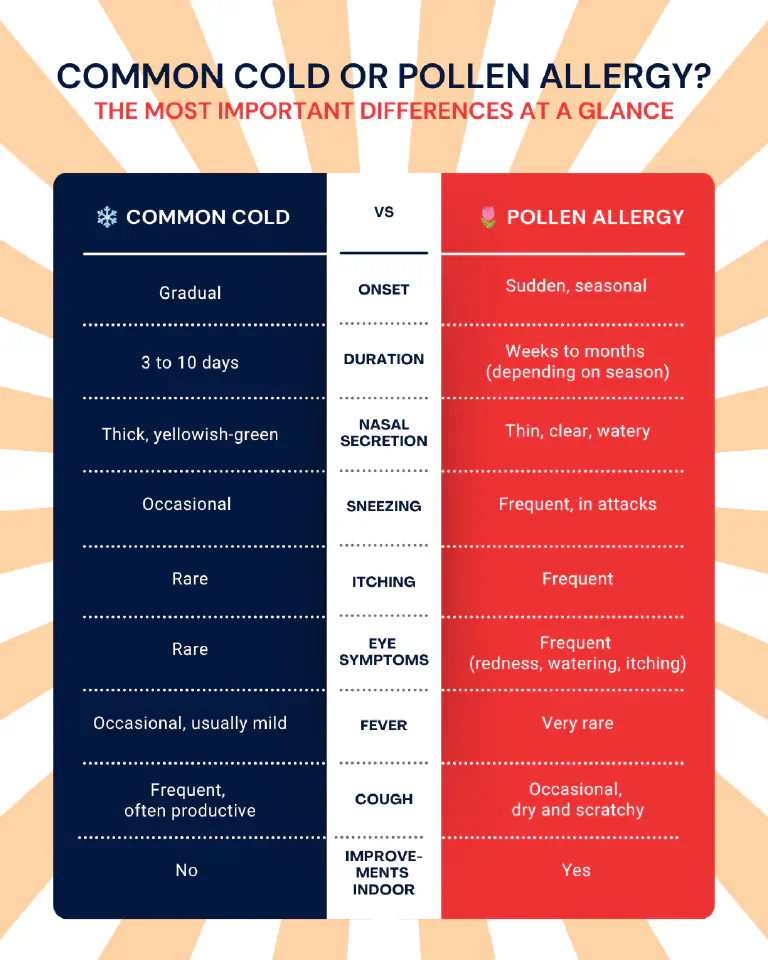
Hay fever symptoms usually appear suddenly and concentrate on the nose, eyes, and airways. A sudden, fit-like urge to sneeze is one of the most noticeable symptoms of a pollen allergy, often accompanied by a runny nose with clear, watery secretion. At the same time, the mucous membranes swell, making it harder for you to breathe through your nose. Your eyes typically react as well. They itch, water, and turn red. Some sufferers also feel a scratchy throat or struggle with fatigue and concentration problems, because the body is constantly running at full speed.
These very hay fever symptoms often lead to confusion with a cold. The most important rule of thumb: A cold comes on gradually, subsides after a week, and is often accompanied by fever and thick, yellowish secretion. Hay fever symptoms, on the other hand, set in abruptly, drag on for weeks, and noticeably improve indoors. The following graphic shows the most important differences at a glance.
When the Allergy Reaches the Airways #
If a pollen allergy goes untreated for years, it can spread to the lower airways. Doctors then speak of a “level shift.” The hay fever in the upper level (nose, eyes) develops into allergic asthma in the lower level (bronchi).
The first signs are a persistent dry cough, a feeling of tightness in the chest, wheezing breath sounds, or shortness of breath during exertion. Studies show that roughly one in three hay fever patients develops allergic asthma over time. If you notice such symptoms in yourself, you shouldn’t wait but should see an allergist promptly. The earlier treatment begins, the better the level shift can be prevented.
Effective Home Remedies for Hay Fever in Everyday Life #
Before you reach for a tablet, it’s worth taking a look in the kitchen. Many home remedies for pollen allergy have an anti-inflammatory, decongestant, or soothing effect on the mucous membranes and can easily be worked into your everyday work routine.
- Turmeric: The spice contains curcumin and has an anti-inflammatory effect.
- Ginger: A freshly brewed tea dampens inflammatory reactions and strengthens the immune system.
- Black seed oil: One to two teaspoons a day provide fatty acids that can ease allergic reactions.
- Chili and horseradish: Contain pungent compounds that act as decongestants on the nasal mucosa and quickly clear the airways.
- Cilantro: Considered a natural antihistamine and can be mixed fresh into salads or soups.
- Apple cider vinegar: A tablespoon in a glass of warm water in the morning can help regulate mucus production.
- Local honey: Contains small amounts of native pollen. Some sufferers report that a daily portion reduces their sensitivity over the long term.

You can also relieve the symptoms from the outside. A nasal rinse with salt water flushes pollen directly off the mucous membranes and noticeably eases your nose. It’s ideal to use it in the evening after work to get rid of the day’s load. For a blocked nose, a steam inhalation also helps, ideally with chamomile or salt. The warm steam moistens your airways and loosens stubborn secretion.
As promising as the list sounds, the effect of home remedies is very individual. What works wonders for a colleague may not help you at all. This is exactly where it pays off to record, over a few weeks, which remedies you’ve tried and how your symptoms developed afterward. Over time, you’ll see in black and white which combination of home remedies for hay fever actually works for you and which ones you can skip.
Diagnosis and Medical Treatment for Hay Fever #
Home remedies are a good start, but with more severe symptoms there’s no way around getting a medical evaluation. Your first point of contact is the allergist, who uses targeted tests to find out exactly what you’re reacting to.
Diagnosis with the Prick Test #
The most common hay fever test is the prick test. Small drops of various allergen solutions are applied to the skin of the forearm and lightly scratched in. If the spot reacts with redness or wheals after about 15 to 20 minutes, the allergen is considered a likely trigger.
A blood test for specific antibodies can be carried out as a supplement, especially when the prick test doesn’t deliver clear results. Only with this diagnosis can your pollen allergy and its symptoms really be treated in a targeted way, because it’s then clear whether you react to birch, grasses, mugwort, or several types of pollen.

Medications for Symptomatic Treatment #
The medication-based treatment of hay fever targets the symptoms and relieves your acute burden. Three groups of active ingredients play the main role.
- Antihistamines block the effect of histamine and thereby relieve the urge to sneeze, itching, and a runny nose. Look for new-generation preparations, as these cause significantly less drowsiness than older active ingredients and are also suitable for the working day.
- Cortisone as a nasal spray or tablet has a strong anti-inflammatory effect and is the treatment of choice for pronounced symptoms. When applied locally, the side effects are considered minimal.
- Cromones stabilize the mast cells and prevent histamine from being released in the first place. They work preventively and should be used before the pollen season begins.
Allergen Immunotherapy as a Long-Term Solution #
While medications only relieve the symptoms, allergen immunotherapy (also called specific immunotherapy) targets the cause. Over a period of about three years, you receive the allergen in increasing doses as an injection or tablet. This way, your immune system gradually gets used to it and reacts much more weakly over time.
This therapy is the only treatment for hay fever that works long-term, and it can reduce the risk of a level shift. Whether it’s an option for you is best clarified directly with your allergist, since the decision depends on your allergens, the severity, and your age.
How to Stay Productive: Behavioral Tips for Pollen Allergies #
The most effective strategy against hay fever is still to let as little pollen near you as possible. With a few targeted adjustments to your daily routine, you can noticeably reduce your pollen allergy without your productivity suffering. Which of these measures makes the biggest difference for you depends on your daily routine and your triggers. Anyone who tries out the tips and records their own symptoms for a few weeks will quickly find out which adjustments are really worth it.
At Home #
- Shower and wash your hair in the evening: During the day, pollen collects in your hair and on your skin. Rinsing it off before bed leads to noticeably more restful sleep.
- Take off clothes outside the bedroom: Otherwise the pollen clings to the fabric and burdens you all night long.
- Air out at the right time: In the city, it’s best to air out between 6 and 8 a.m., in the countryside more like between 7 p.m. and midnight. Keep windows closed outside these times.
- Pollen screens on the window: They keep the majority of pollen out and are a worthwhile investment, especially in the bedroom.
At the Office #
- Air purifier with a HEPA filter: It filters pollen out of the room air and provides noticeably fewer symptoms during long office days.
- Keep windows facing a busy street closed: Even though fresh air seems tempting, the pollen count is often especially high here.
- Keep a salt water nasal spray handy: A quick application at your desk clears your nose without making you drowsy.
On the Go #
- FFP2 mask when commuting or mowing the lawn: What has become established in recent years also reliably protects against pollen.
- Keep car windows closed: If possible, have a pollen filter installed in the ventilation system.
- Schedule sports for low-pollen time windows: After a rain shower, the air is especially clean. At midday and in dry wind, you should rather avoid outdoor sports.
- Take the local pollen season into account when traveling: When planning your vacation, find out about the pollen load at your holiday destination.

Why an Allergy Journal Is the First Step #
A pollen calendar shows you what’s out there. But it says nothing about how strongly exactly you react on a given day. Two people with the same grass allergy can have completely different hay fever symptoms with identical pollen counts. Personal sensitivity, sleep, stress, medication intake, and even humidity all play a part.
That’s exactly why it’s worth recording your own symptoms alongside the pollen count. Anyone who notes for a few weeks when which symptoms occurred and which pollen was dominant at the time will recognize their personal pattern. Suddenly it becomes visible that your eyes itch mainly on windy birch days, or that grass pollen is mainly what robs you of sleep. A simple allergy journal turns vague symptoms into concrete triggers that you and your doctor can work with.
So that you don’t have to start from scratch, we’re providing you with an allergy journal as a free template that comes with everything you need for a clean analysis. It’s ready to use right away and adapts to your daily routine, whether at your desk or on the go on your smartphone.
Using a simple form, you record the date, symptoms, severity of the symptoms, medications taken, and weather conditions in just a few seconds. A visual overview shows you which pollen is active at which point in the season and when your symptoms were especially strong.
Analyze on which days, in which weather, and with which pollen counts your symptoms were the strongest. This way you’ll recognize which pollen actually affects you and which measures really help. At the allergist, you can present your data directly instead of having to rely on your memory. This saves you time and makes your diagnosis more precise.
FAQ: Common Questions About Hay Fever and Pollen Counts #
Which home remedies for hay fever work best at the office?
When should you start medication-based treatment for hay fever?
What are the typical symptoms of a pollen allergy compared to a viral infection?
When is the best time for a hay fever test?
How do pollen counts affect sleep quality, and what can you do?
TAGS: Everyday Life & Leisure