
SWOT analysis explained simply #
What does SWOT stand for? #
Let’s start with a definition. SWOT stands for
- Strengths
- Weaknesses
- Opportunities
- Threats

SWOT analysis © everythingpossible / Adobe Stock
The SWOT analysis is an example of how you can analyze your company (internal) and relevant environmental influences (external).
What is a SWOT analysis? #
In a SWOT analysis, you take stock of your company or team in the form of a matrix. First you look at the internal strengths and weaknesses: Are there innovative products, for example, or do you lack know-how or manpower in one department?
You then analyze the environment of your company or team. Now it is about the external opportunities and threats. How are your markets developing? Are you struggling with rising material costs or new competitors, for example? Or are social trends working in your favor?
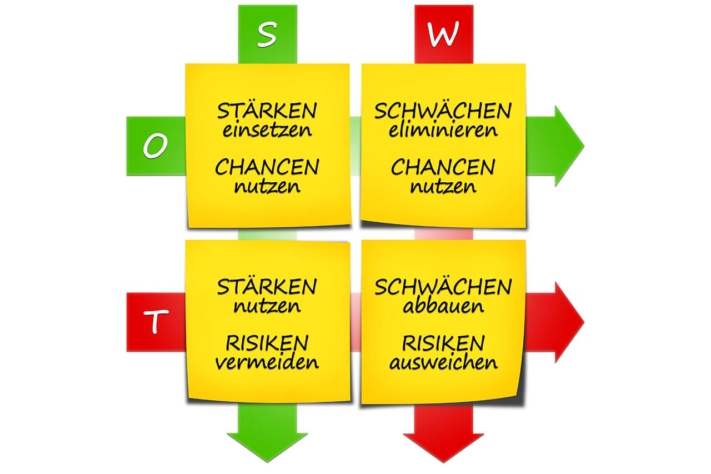
In the second step, you derive strategic recommendations for action from this stocktaking. What do you have to do when opportunities meet weaknesses or threats meet strengths?
SWOT analysis example © r0b_ / Adobe Stock
Since both the environment and internal company factors are taken into account, the SWOT analysis is regarded as an example and an important tool for strategic corporate planning.
How to carry out a SWOT analysis #
The best approach is to plan a workshop in which your teams brainstorm together on the four categories. You should collect all ideas in a matrix. At the beginning, a mind map on a whiteboard or a SWOT analysis template in Excel or Word that explains the SWOT analysis simply can help.
But what belongs in the four categories?
SWOT analysis: Example of the categories #
In the four categories, you analyze the current state of your company and its business environment. Proceed as follows:
- Strengths: Your company’s strengths are all the characteristics that make it stand out from the competition. The SWOT analysis then contains, for example:
- Innovative products
- Outstanding customer service
- Technological know-how
- Weaknesses: Weaknesses represent your company’s disadvantages in general competition. In the SWOT analysis, these can be, for example:
- Dependence on suppliers
- Lack of know-how in product development
- Lack of investment in future technologies
- Opportunities: Opportunities are factors in the business environment that represent advantages for the company. The following are relevant for the SWOT analysis, for example:
- Trends in society
- Legal regulations
- Technological advances
- Threats: Threats, on the other hand, are factors in the business environment that mean disadvantages or even dangers for the company. For example:
- Changes in exchange rates
- New competitors
- Technological developments that will make the product redundant in the future
Also pay attention to the following tips when carrying out your analysis.
Tips for carrying out the SWOT analysis #
When looking at the external factors in a SWOT analysis example, you should bear in mind that a SWOT analysis is about solving two problems. How can you keep pace with market trends and how can you predict and help shape them? After all, you don’t just want to swim with the current, you want to inspire your customers.
You should also choose a SWOT analysis template to make your work easier. The analysis starts with choosing the right tool, and you should also think about putting together the right team.
Taking stock involves a considerable amount of time. Who can you release for the meetings and workshops? Expertise from various departments is also required. Which colleagues have an insight into the strengths, weaknesses, opportunities and threats of your company and its business environment? Ideally, you put together a team of ten employees.

A team talks about a SWOT analysis example © weedezign / Adobe Stock
Another tip: Be creative. Set up the brainstorming workshops in such a way that they bring (new) ideas to light in a playful way.
What strategies can you derive from the analysis? #
The SWOT analysis results in four different strategic directions. To do this, you relate your company’s strengths and weaknesses to the opportunities and threats in the business environment:
- Expand (strength-opportunity combination): Strengths increase the feasibility of your opportunities. Take a look at which opportunities you can successfully exploit with which strengths of your company. Does it make sense to further expand certain business fields or product areas?
- Catch up (weakness-opportunity combination): Is there an opportunity that you can only realize if you compensate for an internal weakness? Your management has to make a decision here: should you invest in making up for the weaknesses? You can then take advantage of the opportunity.
- Secure (strength-threat combination): When assessing threats, you should ask yourself which threats your company can counter with which strengths. Can a strength perhaps even turn a threat into an opportunity if you react early?
- Avoid (weakness-threat combination): Where do weaknesses meet threats? You should be particularly careful here. Consider how you could protect yourself from dangers. Which activities should you avoid, if necessary? Should you withdraw from a business area completely?
Now that you know what can be mapped with a SWOT analysis, it is time for the practical implementation.
Is there a good SWOT analysis template? #
The answer is: yes. There is no shortage of templates for the SWOT analysis. You can find a SWOT analysis example for Excel, Word and similar programs via Google search. The templates are arranged either as a list or in a matrix.
Here you can see a nice SWOT analysis example for companies:
How SeaTable’s SWOT analysis template works #
Would you like to use the SeaTable template to carry out your analysis? Then register on our website in no time at all. In the library you will find the free template, which explains the SWOT analysis simply and is filled out with sample data. Click on Use template and start your analysis.
In the first table, you will find sample entries organized according to the four SWOT categories. In the first column, you enter the factor before determining its origin (internal or external) and assigning it to the individual categories.
Once you have entered all the information, you can view your completed matrix and record possible measures in an action plan. Thanks to the cloud solution, you can access your data from anywhere and at any time and share it with other users.
Conclusion: Carrying out a SWOT analysis with a template #
With a SWOT analysis, you determine where your company stands and can derive scenarios for the future. You use the four categories of strengths, weaknesses, opportunities and threats and consider both internal and external factors.
Register free of charge with SeaTable to get started with your SWOT analysis example. A free template that explains the SWOT analysis simply will help you carry it out.
TAGS: Marketing Planning Build Your Business Data Management & Visualisation Operations