
Whether it’s a business meal, a train ticket or a company cell phone – do you regularly pay for things in advance at work and want to know what you need to consider when it comes to expense reimbursement for employees? Or are you an employer yourself and looking for a way to make the expense reimbursement process more efficient for your employees?
This article not only gives you everything you need to know about expense reimbursement – it also offers you a free template that can make your day-to-day work easier.

As an entrepreneur, it is important to keep track of all expenses.
Definition: What is expense reimbursement? #
The German Income Tax Act defines expense reimbursement as a situation in which an employee incurs expenses in the name and for the account of the employer (advance payment) and is reimbursed for them one-to-one by the company. Under § 3 No. 50 EStG, it is exempt from tax and social security contributions. The exact process and the accepted expense categories can be regulated both by law and internally within the company.
Types of expenses you should know #
Sections 4 and 5 of the German Income Tax Act contain the relevant regulations regarding business expenses. For example, you can have costs incurred in connection with business trips reimbursed as expenses. The same applies to expenses arising from the fulfillment of orders or the provision of services, such as a business meal with your customers. You can also claim purchases or orders such as office supplies or fruit for the office kitchen as reimbursable expenses.
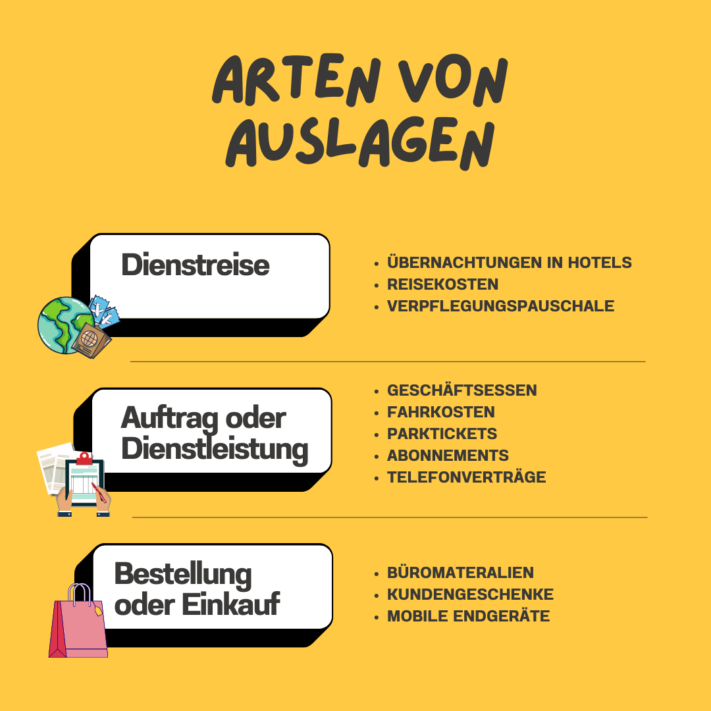
There are various costs that you can have reimbursed as expenses.
Expense reimbursement vs. transitory funds #
Have you already looked into expense reimbursement and come across the term transitory funds? Then you have probably wondered what exactly the difference is. In principle, the same regulations apply to both expense reimbursement and transitory funds. The only difference is the point in time at which the employee receives the money:
- Expense reimbursement: You pay in advance and are only reimbursed after the transaction.
- Transitory funds: You do not have to pay out of your own pocket in advance, but receive the funds from your company before you spend them.
Transitory funds are generally used for foreseeable expenses that are incurred at regular intervals, whereas expense reimbursements tend to be used for one-off expenses.
Exception: Flat-rate expense reimbursement #
Companies can also settle the reimbursement of expenses with a flat rate. These flat-rate amounts can include, for example, travel, meal and accommodation costs. However, you must bear in mind that the tax office sets the maximum rates. The annual maximum for accommodation and meals is 1,000 euros. If you exceed this, an itemized expense reimbursement makes more sense than a flat-rate one.

If you travel a lot for work, you should not rely on flat-rate expense reimbursement.
Conditions for expenses exempt from tax and social security contributions #
According to § 3 No. 50 EStG, expenses are exempt from tax and social security contributions. To ensure that the tax office recognizes the expenses as tax-free, you must meet a few conditions. Here is an overview of the most important ones:
- Earmarking: Only expenses that you incur in the name and at the expense of your company count as reimbursable expenses.
- Documentation: You must prove your expenses with legally valid, original invoices and receipts. For amounts up to 250 euros, a simple receipt is sufficient. According to the current GoBD guidelines, scanning receipts is expressly permitted.
- Work equipment: The expenses must be clearly necessary for business purposes and must not include any private items. If the evidence is unclear, the tax office assumes a benefit in kind.
- Correct settlement: Expenses should be settled properly, with each individual item shown separately on the receipt or invoice.
- Flat-rate expense reimbursement: You must keep traceable records of regular expenses, as the tax office only grants a flat rate if documentation is available for a certain period of time.

Without a good structure, expense reimbursement can quickly overwhelm you.
Challenges you need to master in expense reimbursement #
Expense reimbursement comes with its own challenges. In particular, the bureaucratic effort should not be underestimated – receipts and documentation pile up in folders and take up space. To be able to settle everything in full, every receipt and every invoice must be meticulously submitted. However, there is a risk that the proof gets lost faster than you would like.
The expense reimbursement process is not only time-consuming, but also error-prone, especially if it is still done on paper. You need to be fully focused so as not to accidentally transpose any digits. In addition, there are the tax office’s format requirements to consider, as it only accepts combined PDFs.
Companies and employees must show perseverance and precision during expense reimbursement in order to master the challenge successfully. However, there is no need to worry, because even in the biggest jumble of receipts and forms, there is always a silver lining.
The advantages of digital expense reimbursement for you #
To make expense reimbursement easier and more efficient, it makes sense to use digital methods. This not only gives you a better overview of all expenses incurred, but also reduces the workload thanks to faster recording. By using digital processes, you can achieve a lower error rate, as automated processes leave less room for human error.
Another advantage is increased transparency. Companies can better trace financial transactions by tracking their expenses digitally. The annoying paper chaos that often accompanies traditional methods is completely eliminated. Switching to digital expense reimbursement ensures that your relevant documents are stored in an organized way and are accessible online from anywhere.
Free template for expense reimbursement #
If you want to take the step from analog to digital expense reimbursement, SeaTable’s free template is an excellent option for you.
You can enter your expenses in the table and assign them to custom categories such as office equipment, travel expenses or business meals with a single click. Employees can store digital receipts and invoices directly in the table, ensuring that no proof gets lost. In addition, you can see at a glance which expenses you have already reimbursed and which are still outstanding. After reimbursement, you can easily create documents confirming the reimbursement. The statistics show you at a glance which costs occur most frequently and which you may even be able to reduce.
Register for free on SeaTable and use the template according to your wishes and needs. Keep track of your expense reimbursements and successfully minimize your day-to-day workload.
TAGS: Accounting