
Anyone who lives with several people under one roof knows the situation: dirty dishes are piling up in the sink, the shower drain is clogged, and someone really should vacuum again. But no one feels responsible and the annoying work remains undone. To put an end to the chaos, an individual cleaning schedule for your household is the solution. Here you can find out everything you need to know to create your cleaning schedule.
Why a cleaning schedule is worthwhile #
When many people live in a household, disagreements inevitably arise. This is also true when it comes to cleanliness. Not everyone thinks that they have to wash their dishes immediately or that regular cleaning in the bathroom is necessary.

Dirty dishes accumulate quickly when there is disagreement about cleanliness.
Therefore, it helps to sit down together and create a joint plan that everyone is happy with in the end. If everyone pulls together, the tasks are done quickly and you immediately feel more comfortable in your own four walls. The cleaning schedule assigns the tasks in a binding way, but of course it does not apply for all eternity. If someone is not satisfied, you should adjust the plan and develop it further.
What belongs in a cleaning schedule? #
Now it’s down to the nitty-gritty: you and your roommates want to create a cleaning schedule, but you don’t know where to start? First of all, every plan should be individually tailored to the household. Therefore, start by asking yourself the following questions:
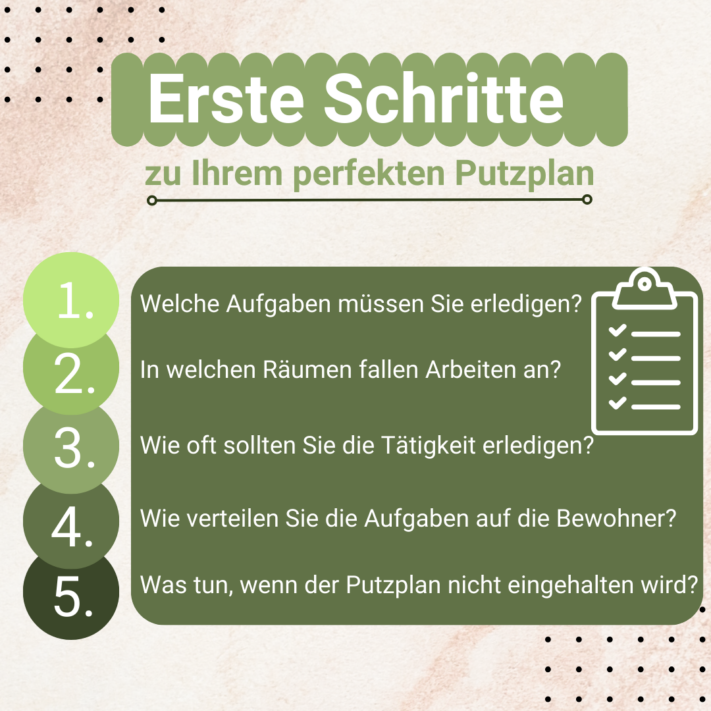
What needs to be done in which room? #
To get a rough overview of the tasks that need to be done, it is helpful to divide them up by room. Basic tasks such as vacuuming, cleaning the floor, taking out the trash, dusting the cupboards, or tidying up come up in all rooms. For specific tasks in the individual rooms, a possible cleaning schedule might look like this:
- Bathroom: clean the toilet, wipe the mirror, descale the faucet, squeegee the shower, air out properly
- Kitchen: keep the countertop clean, dispose of leftovers, wash the dishes, clean the sink, clean the oven, defrost and clean the refrigerator and freezer
- Living room: wipe the TV, shake out the cushions, fold the blankets
- Hallway: tidy up the dresser, keep the coat rack neat, clean the mirror
- Bedroom: make the bed, tidy up the closet, do the laundry (everyone usually takes care of this themselves)
How often does what need to be done? #
The intervals at which certain tasks need to be done depend on how thoroughly they are carried out. If someone does not put any effort into a task in the cleaning schedule, it will have to be done more often to achieve the same result. Nevertheless, we have a guideline for you on which tasks are due how often if they are done thoroughly:
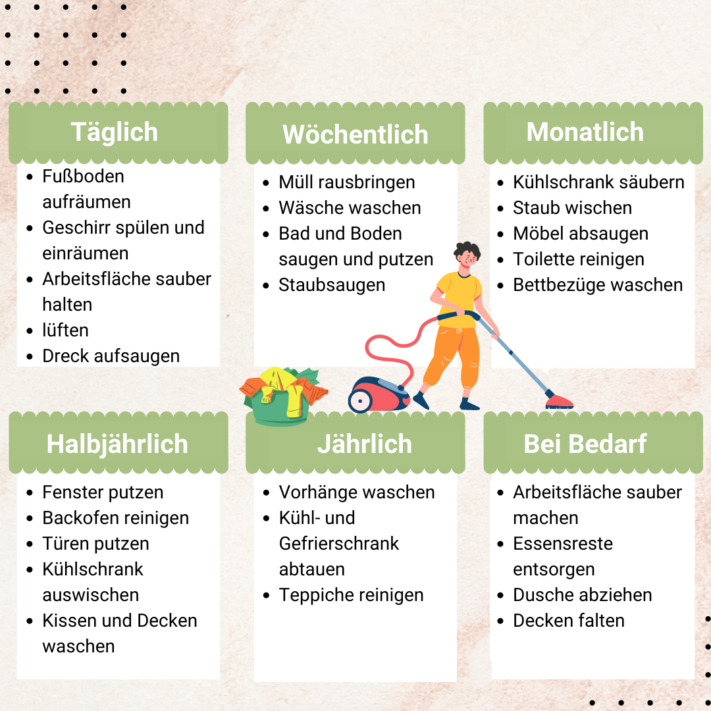
These tasks will come your way at regular intervals.
Distribute tasks fairly #
Decide together who will take on which tasks. Take into account the daily routines of all residents. How much time can you devote to household cleanliness each day? There are different approaches to distributing tasks: Ask about each person’s preferences. Some like to take care of the dishes, while others don’t mind taking out the trash. In the best case, all tasks are already distributed this way.
If this is not the case, another option is to rotate the tasks. In this case, responsibilities change on a weekly basis. This is usually particularly effective, since the workload is roughly the same for everyone after one full rotation and everyone has already been responsible for everything once. However, it takes longer for a certain routine to settle into everyday life.

Teamwork is the key to a successful cleaning schedule.
In order to convince even cleaning slackers of your plan, a creative solution for the distribution of tasks is the key to success. For example, you can draw lots each week to decide who takes on which task. Or you can develop a point system in which each completed task earns points and each of you has to reach a minimum number of points. This is fun and promotes a good atmosphere.
Stay motivated #
The tasks are distributed, but no one does what they should? Then perhaps it’s due to a lack of motivation. No wonder, because cleaning is not exactly one of many people’s favorite activities. To keep the cleaning schedule going anyway, it can help to find the right incentive and to overcome procrastination.

Combine the tedious cleaning with listening to music or watching series. With a little fun while cleaning, everything immediately becomes much easier.
But make sure you don’t get too distracted – cleaning should still be your main focus. Or take advantage of your roommates’ presence and do particularly strenuous tasks together. Another option is to take a playful approach to the whole thing. For example, you can introduce rewards or penalties to spur your roommates on to top performance.
Online cleaning schedule from SeaTable #
There is a lot to plan when it comes to housework, especially if you want to involve several people in the tasks. To help you keep track of everything, the SeaTable team has created a cleaning schedule template for you. You can customize it to your needs as you like. For example, by clearly assigning tasks to a responsible person, you can see at a glance which tasks you and your roommates have to do and whether they are distributed fairly.
If you want to use SeaTable to create your individual cleaning schedule, simply register for free.
TAGS: Everyday Life & Leisure